Showing posts with label Llewellyn Blog. Show all posts

Tuesday, April 9, 2013

Llewellyn Publishing and Christian Segregationist Wolves in Pagan Sheep's Clothing


One participant at the International Festival of Golden Dawn Magicians, today informed us that another Golden Dawn order, the other party of the famous Golden Dawn trademark settlement agreement (here) claimed at Pantheacon 2013 that their order "is bringing Paganism into the Golden Dawn."

I was quite surprised by this odd claim, considering that the order in question is led by Llewellyn authors who also lead segregationist, "Christian only" esoteric orders. You can read more about this subterfuge, documenting its connection to Llewellyn publishing HERE.

The Pagan led Hermetic Order of the Golden Dawn and its parent order, the Rosicrucian Order of Alpha Omega, initially applauded the new, allegedly "pro-Pagan" stance of that order, even though it seemed somewhat hard to believe, since two of their leaders also lead Christian segregationist orders. 

By a bizarre twist of fate, the other shoe dropped today when a spokesperson for the same G.D. group again wrote that "all modern Magick is of CHRISTIAN origin and that there is no such thing as ancient Egyptian Magic." This is not the first time that representatives of this G.D. group led by segregationist, "Christians only" Llewellyn authors, have published this argument.  HERE is one example. We have refuted this already in the past as well (for example HERE).

Since the Alpha Omega is ecumenical and non-sectarian, we invited even leaders and members of that order to come and examine the A.O.'s Egyptian Magic for themselves at this week's International Festival of Golden Dawn Magicians. Instead segregationist leaders threatened their members with expulsion if they came to the Festival.

Why is it that their Christian led Golden Dawn order, on the one hand, behaves in such a blatently sectarian manner, yet at Pagan events pretends they are "bringing Paganism into the Golden Dawn?"

Actions speak louder than words.

In any case, we have already refuted that tired argument in the past (for example here). It is in reality Christianity itself that is a reformulation of ancient Egyptian and other Pagan traditions - and not the other way around as the wolves in sheep's clothing would like you to believe.

Take, for example, the "mythical" story of the life of Jesus Christ himself, which has been "borrowed" nearly wholesale from Egyptian myths of the life of Horus!

Check this out:
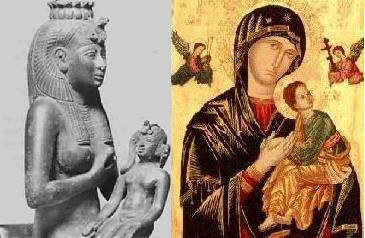

Check these parallels:
  1. Both were conceived of a virgin.
  2. Both were the "only begotten son" of a god (either Osiris or Yahweh)
  3. Horus's mother was Meri, Jesus's mother was Mary.
  4. Horus's foster father was called Jo-Seph, and Jesus's foster father was Joseph.
  5. Both foster fathers were of royal descent.
  6. Both were born in a cave (although sometimes Jesus is said to have been born in a stable).
  7. Both had their coming announced to their mother by an angel.
  8. Horus; birth was heralded by the star Sirius (the morning star). Jesus had his birth heralded by a star in the East (the sun rises in the East).
  9. Ancient Egyptians celebrated the birth of Horus on December 21 (the Winter Solstice). Modern Christians celebrate the birth of Jesus on December 25.
  10. Both births were announced by angels (this si nto the same as number 7).
  11. Both had shepherds witnessing the birth.
  12. Horus was visited at birth by "three solar deities" and Jesus was visited by "three wise men".
  13. After the birth of Horus, Herut tried to have Horus murdered. After the birth of Jesus, Herod tried to have Jesus murdered.
  14. To hide from Herut, the god That tells Isis, "Come, thou goddess Isis, hide thyself with thy child." To hide from Herod, an angel tells Joseph to "arise and take the young child and his mother and flee into Egypt."
  15. When Horus came of age, he had a special ritual where his eye was restored. When Jesus (and other Jews) come of age, they have a special ritual called a Bar Mitzvah.
  16. Both Horus and Jesus were 12 at this coming-of-age ritual.
  17. Neither have any official recorded life histories between the ages of 12 and 30.
  18. Horus was baptized in the river Eridanus. Jesus was baptized in the river Jordan.
  19. Both were baptized at age 30.
  20. Horus was baptized by Anup the Baptizer. Jesus was baptized by John the Baptist.
  21. Both Anup and John were later beheaded.
  22. Horus was taken from the desert of Amenta up a high mountain to be tempted by his arch-rival Set. Jesus was taken from the desert in Palestine up a high mountain to be tempted by his arch-rival Satan.
  23. Both Horus and Jesus successfully resist this temptation.
  24. Both have 12 disciples.
  25. Both walked on water, cast out demons, healed the sick, and restored sight to the blind.
  26. Horus "stilled the sea by his power." Jesus commanded the sea to be still by saying, "Peace, be still."
  27. Horus raised his dead father (Osiris) from the grave. Jesus raised Lazarus from the grave. (Note the similarity in names when you say them out loud. Further, Osiris was also known as Asar, which is El-Asar in Hebrew, which is El-Asarus in Latin.)
  28. Osiris was raised in the town of Anu. Lazarus was raised in Bethanu (literally, "house of Anu").
  29. Both gods delivered a Sermon on the Mount.
  30. Both were crucified.
  31. Both were crucified next to two thieves.
  32. Both were buried in a tomb.
  33. Horus was sent to Hell and resurrected in 3 days. Jesus was sent to Hell and came back "three days" later (although Friday night to Sunday morning is hardly three days).
  34. Both had their resurrection announced by women.
  35. Both are supposed to return for a 1000-year reign.
  36. Horus is known as KRST, the anointed one. Jesus was known as the Christ (which means "anointed one").
  37. Both Jesus and Horus have been called the good shepherd, the lamb of God, the bread of life, the son of man, the Word, the fisher, and the winnower.
  38. Both are associated with the zodiac sign of Pisces (the fish).
  39. Both are associated with the symbols of the fish, the beetle, the vine, and the shepherd's crook.
  40. Horus was born in Anu ("the place of bread") and Jesus was born in Bethlehem ("the house of bread").
  41. "The infant Horus was carried out of Egypt to escape the wrath of Typhon. The infant Jesus was carried into Egypt to escape the wrath of Herod. Concerning the infant Jesus, the New Testament states the following prophecy: 'Out of Egypt have I called my son.'"
  42. Both were transfigured on the mount.
  43. The catacombs of Rome have pictures of the infant Horus being held by his mother, not unlike the modern-day images of "Madonna and Child."
  44. Noted English author C. W. King says that both Isis and Mary are called "Immaculate".
  45. Horus says: "Osiris, I am your son, come to glorify your soul, and to give you even more power." And Jesus says: "Now is the Son of Man glorified and God is glorified in him. If God is glorified in him, God will glorify the Son in himself, and will glorify him at once."
  46. Horus was identified with the Tau (cross).

Tuesday, March 5, 2013

EXPOSED: Llewellyn Blog Mistakes Mysticism for Magick (Answer to Donald Michael Kraig)


by Golden Dawn Imperator
David Griffin

Today there remains a tragic amount of confusion among aspiring Magicians about the very real differences between Mysticism and Magick.

All science grows in three main phases. These are (1) a common vocabulary, (2) correlation, and (3) effect-cause-effect. This means that every known science began by first establishing a common vocabulary that permitted its proponents to communicate. Without a clear definition of each term, conversations end up turning into arguments even when both sides are actually proclaiming the same truths.

Aristotle was quite adamant that we must always begin by clarifying our terms. Unfortunately, when important terms and concepts, such as “Magick” and “Mysticism” are used with imprecision, we end up fighting about something that isn’t really important. I won’t bother with the last two phases as they are not relevant to this discussion.

Donald Michael Kraig recently published an article entitled "The Dark Night of the Soul." You can read the entire article over on the Llewellyn blog here. I am concerned about the level of confusion perpetuated in the Magical community by this article through imprecise use of the terms "Mysticism" with "Magick."

In "Dark Night of the Soul," Kraig draws a distinction between what he calls "technological/spiritual Magick" and "Religious Magick," yet goes on to describe both of these forms of so-called "Magick" in purely Mystical terms.

From the perspective of the Hermetic and Magical traditions, including luminaries such as Giordano Bruno, Marcilio Ficino, Cornelius Agrippa, Gerolamo Cardano, Pietro D'Abano, Theophrastus Paracelsus, and Eliphas Levi (not to mention the entirety of Egyptian, Chaldeaen, and Sumerian Magick) what Kraig describes is not really Magick at all, but pure Mysticism.

Kraig is absolutely correct that what he calls "Religious Magick," or "seeking a direct relationship between the Divine and the practitioner" is actually Mysticism. But why call Mysticism "Religious Magick" at all?

Mysticism is Mysticism. Magick is something else. Calling Mysticism "Magick" merely creates unnecessary confusion.

As for what Kraig calls "technological/spiritual Magick," which Kraig defines as "Attuning oneself with the Divine," this is not Magick at all either, at least from the point of view of centuries of Hermetic and Magical tradition.

This also is Mysticism, pure and simple. According to long established Hermetic and Magical tradition, Kraig in reality is contrasting two different aspects of Mysticism, which he mistakenly calls "Magick."

Kraig's conflation of the terms "Magick" and "Mysticism" perfectly mirrors the utter bewilderment about the real differences between Magick and Mysticism that plagues today's esoteric community. Sadly, interchangeable and imprecise usage of these terms, such as Kraig's usage in the article under discussion, perpetuates such confusion rather than clarifying and eliminating it.

I have written extensively previously on the differences between Mysticism and Magick (here). I repeat the most relevant aspects, as follows:
"Mysticism and Magick are two quite distinct spiritual paths. The primary difference between Magick and Mysticism lies codified in the actual methods of practice, together with the Mystical or Magical inclinations of the practitioner. 
The Mystical path refers to the capacity and will of the practitioner to place oneself in a passive position in relationship to eternal Being and the forces of nature, which the Practitioner begins to invoke and pray to, so they may manifest and enlighten one, thus spiritually uplifting and exalting the practitioner.  
The Magical practitioner, on the other hand, does not place him or herself in a passive state towards natural and Divine forces, but rather in a positive state. Recognizing the Divine Spark inside oneself, the practitioner actively collaborates with Eternal Being rather than waiting for its manifestations. 
In Mysticism, the practitioner expects Divinity to manifest itself, and to ascend the staircase that leads from below to on high aided by the Divine hand that takes us and leads us ever upwards. 
Magic does not expect this, instead conquering the Inner Planes through one's own effort rather than through Divine aid. Thus, whereas the Mystical approach is one of submission, the Magician instead is a conquerer. 
A perfect example of the Magical path may be found in the Mithraic Ritual deposited in Paris, which shows one such practice of divine Ascension of the Magical initiate. While rising towards Divinity to be received like a prodigal Son or Daughter, the practitioner greets the Gods as equals that gradually appear, not fearing them or subjugating oneself before them, but admonishing them and blandishing them with Magical words that open the gates of heaven. 
Whereas Magick is based on knowledge, Mysticism is based on on ignorance in the literal sense of "ignoring" or "unknowing." In fact, one of the most important mystical texts in all of Christianity, "The Cloud of Unknowing," speaks of making oneself obscure, humble and ignorant before the unmanifest - to remain there, in silence, gradually emptying oneself, while waiting for something or someone (God) to come and fill the void thus created. 
Thus two completely different modalities become evident. Whereas the Mystic reflects the Divine light that is poured out upon him, the Magician generates this light, becoming an emitter himself.  
A.E. Waite
The foremost exponent of the Mystical path in the Golden Dawn was Arthur Edward Waite, who completely suppressed Magick in favor of Christian Mysticism in his Fellowship of the Rosy Cross and its Inner Order, the Rosa Rossa et Aureae Crucis (Rectified Rite). Waite's Fellowship of the Rosy Cross, reconstructed in recent years and open only to Christians, today remains the most Mystical order in the Golden Dawn community. 
The foremost exponent of the Magical path in the Golden Dawn was the great Mage, S.L. MacGregor Mathers. Mathers understood that the Golden Dawn primarily as a Magical rather than a Mystical tradition. Over time the Magical spiritual path has become more and more pronounced in Mathers' Alpha Omega. The A.O. today remains the most Magical order in the Golden Dawn community. 
In between the Alpha Omega and the Fellowship of the Rosy Cross, which most clearly exemplify the diametrically opposed Magical and Mystical Golden Dawn paths, there today exist a host of Golden Dawn orders that lie somewhere in between ... that have not gone so far as to suppress Magick outright as did the Waite order, yet nonetheless remain quite Mystical in their approach to the Golden Dawn."
Although this will likely come as a surprise to many of Donald Michael Kraig's readers, judging by what Kraig has written in "Dark Night of the Soul," Kraig's underlying philosophical approach to occultisim, the Golden Dawn, and Magick in general, is not really a Magical approach at all, but rather a Mystical approach instead.

This does not mean that Kraig's books do not include a great deal of Magical techniques, albeit borrowed from other sources. Clearly they do. For example, Kraig's Modern Magick borrows heavily from published Golden Dawn material.

Nonetheless, to one versed in the literature of the history of Magick and of Hermeticism, it is obvious that Kraig's underlying philosophical position and personal approach to esoteric work is consistently that of Mysticism, rather than that of Magick.

Although this may astonish some of Kraig's readers, it should nonetheless come as no surprise, considering that Kraig is both a member and a covert public representative of one of the most mystically oriented of all Golden Dawn orders.

If one analyses Kraig's writings carefully, it becomes readily apparent that Donald Michael Kraig has for decades been a primary exponent of the Mystical approach, both to occultism in general, and to the Golden Dawn in particular.

Thus we should not be surprised that the arguments contained in Kraig's latest article conflate the Mystical "Dark Night of the Soul" of the Christian Mystic, St. John of the Cross, with the thoroughly Magical "Crossing of the Abyss," which occurs during the transition between the classical Golden Dawn's Second and Third Orders.

There is precious little I may reveal in public about the true nature of this perilous "Crossing of the Abyss" between the Golden Dawn's Second and Third orders, since this remains oath bound information in the A.O. Let me give a hint, at least, as to the true nature of this Magical (not Mystical) process, however, with the following piece of prose:

The Abyss
We on Earth live in a house of mirrors.
We are like deluded rats running on a wheel in a cage, chasing our cherished illusions. 
Read a book, perform a rite, or perhaps even a guided fantasy... 
... and "Abracadabra!" - Now we are "Self-Initiates." 
Get depressed, find a book in a store front window, overcome the depression ... 
and "Shazaam!" - Now we have "Crossed the Abyss!" 
Is there really nothing more to Magick than what is likely but self-inflicted delusion? 
Is there no exit from the house of mirrors? 
Is there no way past the perilous Minotaur - and OUT of the labyrinth - once and for all?


Is it any wonder that the esoteric community remains so confused about the differences between Mysticism and Magick, when even respected occult authors like Donald Michael Kraig and publishing houses like Llewellyn perpetuate such bewilderment with imprecise use of key terms?

It is important that the actual differences between Magick and Mysticism, as established by many centuries of Magical and Hermetic tradition, be clarified in the public mind rather than further obfuscated.

It is also important that the public comes to fully understand the fundamental difference between the Magical versus the Mystical approach to esotericism - and that they are not at all the same.

It is lastly important that the public comes to understand the fundamental philosophical differences between mystically vs. magically oriented Golden Dawn orders, as well as the difference this makes in practical approach for the spiritual development of initiates, despite that most Golden Dawn orders appear the same when superficially examined.

Let us be clear about one thing.

In the Alpha Omega, we do not make Mystics.

To make Mystics is the mission of religions, churches, and mystically oriented Golden Dawn orders. This is not the mission of the Alpha Omega.

The mission of the Alpha Omega instead is like the first rays of dawn bursting across the sea, banishing shadows, eliminating confusion - And making clear the difference between Mysticism and Magick for legitimate seekers - tired of groping around in the dark alone.


Alpha Omega
Because we make Magicians!

Click HERE to explore our Outer Order, undergraduate level Magical training program, the Hermetic Order of the Golden Dawn!"

Don't miss:

Monday, February 4, 2013

The Llewellyn-Donald Michael Kraig-Concurrence Kerfuffle

by Golden Dawn Imperator
David Griffin

My recent article  about Astral-only initiation showing the positions of leaders across the spectrum of the Golden Dawn community, seems to have stirred up a bit of a kerfuffel with Donald Michael Kraig. You can read parts one and two of this apparently controversial article here and here.

In the article, I merely pulled together the written positions of leaders across the Golden Dawn community, showing how there is wide consensus about many aspects of claims made by proponents of Astral-only Initiation.

It seems that to some, however, being seen as holding written positions corresponding closely with mine, feels like the moral equivalent of catching cooties in the first grade.

At the heart of the hubbub lies a divergent interpretation of the word  "cooties."  Oops! Sorry. I mean the word "concur."

Trying to keep a scholarly tone, and considering that each of these G.D. leaders' positions is based on many years of independent research, I pointed out in the article how frequently our written positions concur with one another when it comes to Astral-only Initiation.

Donald Michael Kraig, clearly unhappy about this, then wrote here:
"I wish to make it known that unless I specifically say so in writing, I neither concur nor do not concur with any policy in Mr. Griffin's group or any other group. If some individual or group agrees with what I have written, they are concurring with me, and not vice versa. 
In this particular instance, I do not have access to any of Mr. Griffin's documents, beliefs, or policies. I have not requested them. I am not interested in them. Therefore, it is incorrect to say that I concur with Mr. Griffin or his group. Is it possible that I might? It's impossible to say. However at this time it is false to claim that I do."
Sigh.

All I did was to point out that there exist concurrences between our written positions, not that Don and I are having some sort of secret bromance, or even (heaven forbid) that we as persons might occasionally agree about something.

I admit that, at this point, my frustration was such that I was tempted to post a picture of Mit Romney, saying: "I neither concur nor do not concur." 

Instead, I swallowed my pride, extended the olive branch even further, and clarified here my use of the word "concur," even suggesting an alternative nomenclature that Don might find less contentious:

Care Frater Don, 
It sounds like word "concur" may somehow be a bit too strong for you or perhaps has a connotation for you that remains unknown to me.
According to the Oxford dictionary, the definition of the word concur is:
verb (concurs, concurring, concurred)
[no object]
• 1 be of the same opinion; agree:
the authors concurred with the majority
[with direct speech]:
‘That’s right,’ the chairman concurred
• (concur with) agree with (a decision or opinion):
we strongly concur with this recommendation
• 2 happen or occur at the same time; coincide:
in tests, cytogenetic determination has been found to concur with enzymatic determination 
It is in this sense and no other that I use the word "concur" in the article. 
Is there another word you would prefer when discussing areas where our writings indicate we have independently reached similar conclusions in our research or we hold similar opinions or beliefs in specific areas? 
Would you prefer the use of “similar opinion” or "similar conclusion" rather than “concur? ”
Respectfully,
David Griffin
I was optimistic that the above clarification would put the entire matter to rest. I had never said to begin with that Don agrees with or endorses me personally. I only pointed out how our written positions demonstrate concurrence about several of the specific claims made by proponents of Astral-only Initiation.

I certainly never wrote that Kraig endorses the Alpha Omega, which no one in the Golden Dawn community would believe anyway, considering that Frater Kraig's Golden Dawn order and the A.O. have a long history of litigation - and even a non-disparagement agreement (paragraph 4 here) prohibiting our even mentioning one another's groups on-line!

I was therefore somewhat surprised when Don instead escalated the hullabaloo, dragging even Llewellyn Publishing into the foofaraw, by writing on the Llewellyn blog here:
"If you read something and agree with what I wrote, it means that you concur or agree with me. It does not mean that I agree with you. I might. I might not. I would have to see everything that you believe and have written before I give my endorsement. Saying that I agree with you just from what I’ve written would require you to read my mind and determine my thoughts. You have no evidence that I in any way agree with you, concur with you, or endorse you. The only accurate thing you can say is that you agree with me."
and
"Unless you see, in writing that is published under my name, that I agree with, support or concur with an individual or group, I neither support nor do not support them."

"Really?"

"Donald Michael Kraig said that?!?
... And on the Llewellyn Blog?!?"
Cooties ... Really ...

At least one thing is certain. It is clear Donald Michael Kraig feels passionate about the word    "cooties."  "concur."

But seriously ...

I sincerely regret Don Kraig is unhappy that he and I fully agree in some areas. However, arguing against those points only divides the Golden Dawn Community rather than brings it together. 

I also regret putting Kraig on the spot for finding common ground between our written positions, but my goal to make Magicians requires finding common ground that unites the Golden Dawn community wherever it is found.

I understand Frater Kraig's political allegiance and respect that he is trying to remain dutiful, but sooner or later, all Golden Dawn leaders must learn to work together or destroy the community.

The Golden Dawn community wants harmony. The time has come for Golden Dawn leaders to focus on what we share in common rather than the differences that divide us.

To do otherwise is to abdicate the great responsibility our students have placed in us.

"All we are saying, is give peace a chance."

Alpha Ωmega Mystery School Livestream